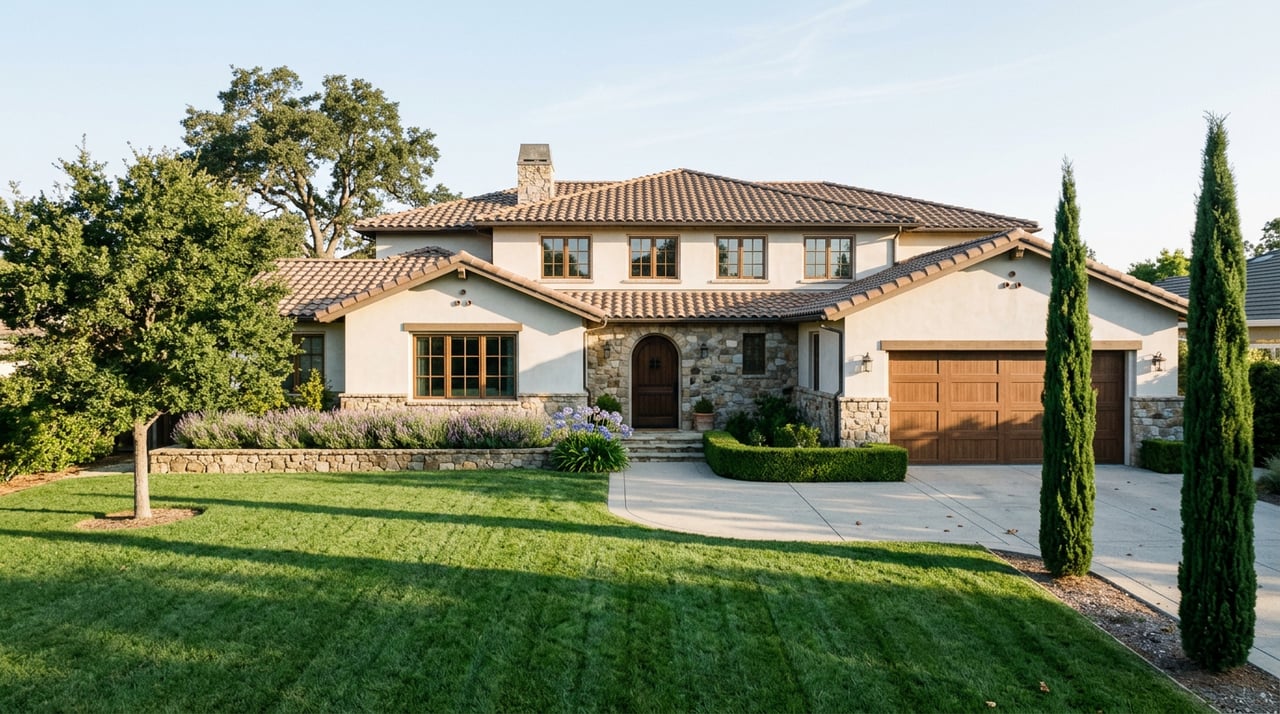
Ask anyone tracking the headline numbers and they'll tell you Danville's housing market cooled off this year. Redfin puts the median sale price at $1.8 million for the three months ending June 2026, down 7.6% from the same stretch a year earlier. Zillow's home value index, which smooths out the noise from a handful of outsized sales, landed at $1,869,416 in June 2026, down 7.9% year over year. By that read, Danville looks like a market catching its breath.
Then the Contra Costa County Assessor's Office released its 2026-2027 assessment roll in July, and the story flipped. Danville's total assessed value grew 4.41% over the past year, the second-fastest increase of any city in the county, trailing only Oakley's 4.44%. That's on a countywide roll that just crossed $300.80 billion in total assessed value, the highest in the county's history, even as the overall growth rate slowed to 3.48% from the prior year's 4.18%.
Two official numbers, pointing in opposite directions, about the same town, in the same year. That contradiction isn't a data error. It's the most useful fact a Danville buyer will find this year, because it explains something the median price can't.
What the Assessor Actually Counted
Home prices and assessed values measure different things, and the gap between them is where the real story sits. A median sale price tracks what buyers paid for whatever happened to change hands in a given window. An assessment roll tracks the total taxable value of every parcel in the city, and under Proposition 13, that number moves in one of exactly two ways: either an existing owner's assessed value creeps up by the statutory cap of 2% a year, or a parcel gets reassessed to full market value because of a sale, a completed rebuild, or new construction.
That second category is doing almost all the work in Danville's 4.41% jump. A town where resale prices are softening should not be posting one of the fastest-growing tax rolls in the county unless something else is adding brand-new value underneath the surface. Something else is.
The Two Markets Hiding Inside One Headline
Redfin's own numbers hint at the split. The same dataset that shows the median sale price down 7.6% also shows the average Danville house price hitting $1.9 million in July 2026, up 25.6% year over year. A median and an average moving in opposite directions in the same market is a signature move of a bifurcated market: a batch of very large, very new transactions pulling the average up while the typical resale cools.
Where are those large transactions coming from? Follow the construction activity and the answer is specific streets, not an abstract trend.
On the west side, Vista Oaks by Edenbridge Homes is placing new estate homes on half-acre lots with views toward the Las Trampas Range, each one landing on the tax roll at its full 2026 sale price rather than whatever a prior owner paid decades ago. Near downtown, The Nova is bringing 50 single-level, age-restricted residences designed by FORM4 Architecture with interiors by LKM Interior Design, and just a few blocks away, 600 Hartz is adding 36 luxury residences around a landscaped courtyard. None of these are replacing an existing assessed value at a small increment. Each one is a brand-new number added to the roll at full market price.
Then there's the teardown corridor. Up on El Pintado Loop, a builder recently listed a bare parcel at $1.495 million with plans already drawn for a roughly 5,500-square-foot custom home and an ADU, a price that reflects nothing but the right to build. Down the street from there, 6 Charolais Court sold as new construction at $3.8265 million. Abbes Construction, a design-build firm based in Danville with more than 35 years working in the town, describes a well-executed teardown-rebuild as "one of the highest-ROI moves available to Danville property owners," and the tax mechanics explain why that framing holds up: the old, decades-assessed home comes off the roll and a new, full-value assessment takes its place.
One Median Price Is Hiding Several Different Danvilles
The reason a single townwide number flattens all of this into a single, misleading figure is that Danville isn't one price tier. It's several, sitting close enough together on a map to share a zip code but far enough apart in value that a buyer comparing "Danville" to a neighboring town on price alone is comparing an average of averages.
| Danville micro-market | Approximate recent median |
|---|---|
| West Side Danville | $2.66 million |
| Sycamore Valley | $2.10 million |
| North Sycamore | $1.87 million |
| Greenbrook / Danville South | $1.72 million |
| Crow Canyon Country Club | $1.20 million |
| La Gonda Way / West El Pintado | $965,000 |
That's not a small spread. It's nearly a three-to-one gap between the highest and lowest pockets, all inside one town. When the assessment roll shows Danville's total value climbing faster than almost anywhere else in the county, it's climbing fastest in the pockets where the teardown-rebuild and new-construction activity is concentrated, which skews toward the higher end of that table, not evenly across it.
What This Actually Means for Your Tax Bill
If you're comparing Danville against another Contra Costa town using a countywide average tax rate, stop. Prop 13 sets the base rate at 1% of assessed value, and voter-approved bonds typically add enough on top that most Contra Costa buyers land somewhere between 1.1% and 1.4% of their purchase price in the first year. Your assessed value resets to whatever you paid the moment you close, then rises no more than 2% a year after that. Your neighbor, if they bought in 2005 or 1995, is still working off that year's price plus a couple decades of 2% increases. Their bill and yours will never look alike, regardless of what either of your houses is worth on paper today.
New buyers also run into a bill that doesn't arrive with the rest of the paperwork. According to JVM Lending, because the regular tax bill for the year is calculated before your sale closes, the county issues a separate supplemental bill afterward covering the gap between the seller's old assessed value and your new one, prorated for whatever's left in the fiscal year that runs July through June. Buy in January and you could owe roughly six months of that difference on a bill that shows up well after you've moved in. It's a normal part of buying in California, but it catches people off guard because it looks like a second tax bill nobody mentioned at closing.
If You're Eyeing One of Those Older El Pintado or Sycamore Valley Lots
Buyers drawn to Danville's rebuild corridor should run the numbers on both sides of the ledger before falling for a lot. Custom construction in Danville typically runs $450 to $650 per square foot, with estate-level builds in the Blackhawk neighborhood and the adjacent Diablo Country Club area reaching past $800. A finished 4,000-square-foot home at the upper end of that range represents a real construction cost on top of the land, and the resulting assessed value, set at completion, will reflect the full finished product, not the modest number the prior ranch house carried for thirty years. That's the tradeoff behind every one of those "ripe for teardown" listings: the long-term tax basis you're locking in is brand new, not inherited.
For sellers in that same generation of ranch homes, particularly those 55 or older, Proposition 19 allows a low existing assessed value to transfer to a replacement home purchased anywhere in California, which changes the math considerably for anyone weighing whether to sell an older Danville property and buy smaller nearby rather than stay put simply to protect a tax basis.
The Number Worth Watching
A soft median price and a strong assessment roll can both be true at once, and in Danville right now, they are. The roll is the better signal for where the town's high-end construction pipeline is actually landing. The median is the better signal for what a typical existing home is doing on resale. Neither one alone tells a buyer what they need to know, which is exactly why comparing Danville to Alamo or Walnut Creek on a single headline number will mislead you before you've even scheduled a tour.
If you're weighing a move into one of Danville's micro-markets, or trying to figure out what a specific street's tax history actually looks like against its current asking price, that's the kind of parcel-level digging Holman Stone does before you write an offer. Request a free home valuation and we'll walk you through what a specific Danville address is really carrying in assessed value, not just what the listing says it's worth.
This article is general information, not legal, tax or financial advice. Consult a qualified professional about your situation.